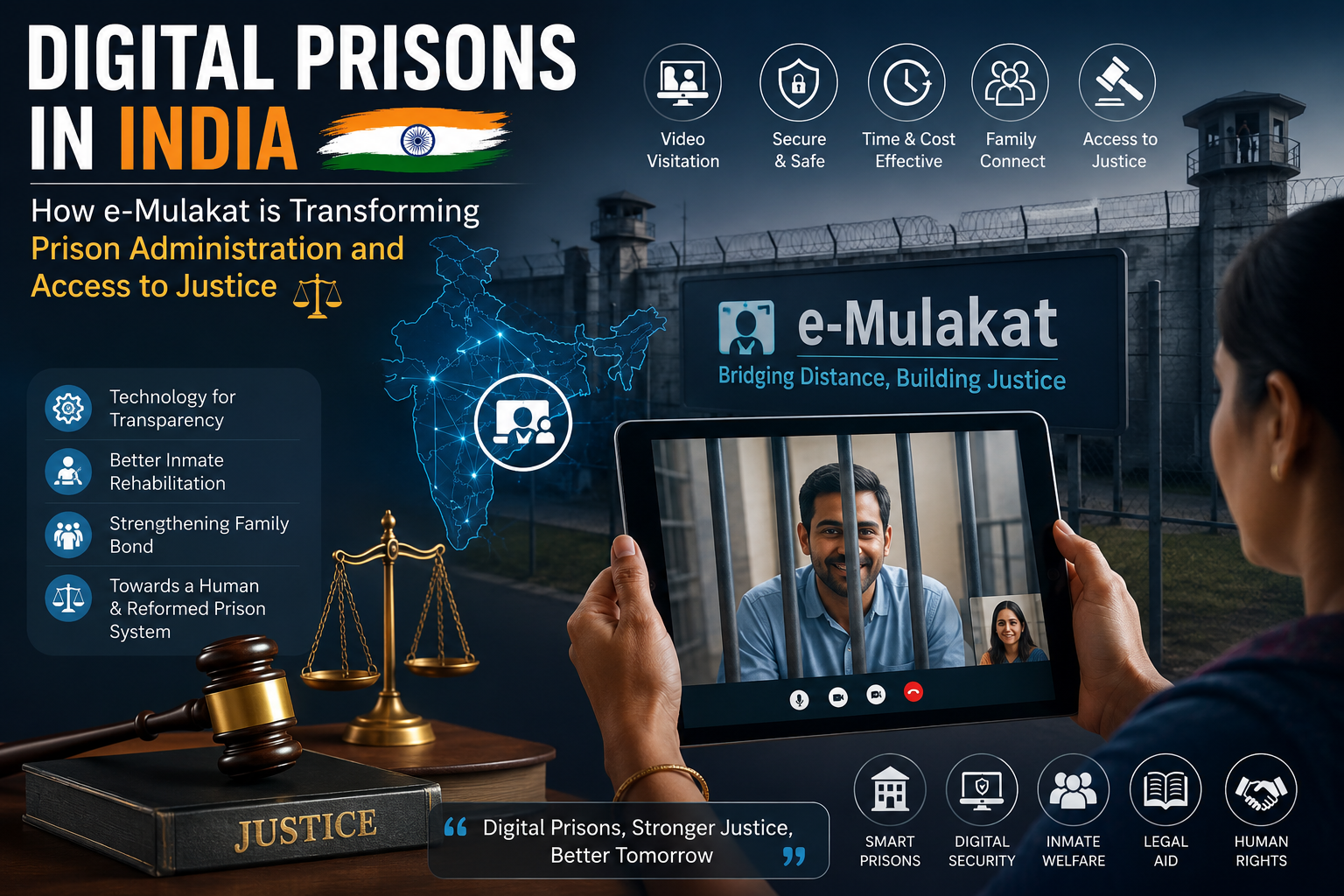
🌐 Introduction
Imagine a prison where family members can meet inmates without travelling hundreds of kilometres, lawyers can consult their clients through secure digital platforms, prison records are maintained electronically, and administrative decisions are supported by technology rather than bulky paper files.
A decade ago, this would have seemed futuristic. Today, it is gradually becoming a reality in India.
India is witnessing a significant transformation in prison administration through the adoption of digital technologies. While courts, police, and government departments have rapidly embraced digitization under the Digital India Mission, prisons are also evolving into Digital Prisons. This transformation aims not only to improve administrative efficiency but also to protect the constitutional and human rights of prisoners.
Among the most impactful innovations is e-Mulakat, an online system that enables prisoners to interact with their family members and legal representatives through video conferencing. Initially introduced to address practical and security concerns, especially during the COVID-19 pandemic, e-Mulakat has now become an important tool for maintaining family relationships, facilitating legal consultations, and improving prison management.
Digital prison initiatives extend beyond video meetings. Today, many prisons are adopting technologies such as:
💻 Electronic Prison Management Systems
📱 Digital Prison Records
🎥 CCTV-based Monitoring
🔐 Biometric Identification
🤖 AI-assisted Security Systems
📂 Online Visitor Management
⚖️ Digital Court Production through Video Conferencing
📑 Electronic Health Records of Prisoners
Collectively, these reforms are reshaping India's correctional institutions into more transparent, accountable, and technology-driven systems.
However, digitization also raises important legal questions:
❓Does every prisoner have a legal right to e-Mulakat?
❓Can digital meetings replace physical prison visits?
❓Are video conversations private?
❓Can lawyers confidentially consult clients through online platforms?
❓How does digital prison administration affect Article 21 of the Constitution?
❓What happens if technical failures prevent legal consultation?
❓How secure is prisoners' personal data?
These questions lie at the intersection of constitutional law, prison administration, technology law, and human rights.
This article explores India's emerging digital prison ecosystem with special emphasis on e-Mulakat, its legal framework, constitutional foundations, practical implementation, challenges, judicial developments, and future prospects.
🏛️ What Are Digital Prisons?
The term Digital Prison refers to the integration of information technology into prison administration for improving governance, security, transparency, efficiency, and prisoner welfare.
Unlike the traditional prison model—which relied heavily on paper records, manual registers, and physical interactions—a digital prison functions through interconnected electronic systems.
Digital prison administration generally includes:
✅ Online prisoner database
✅ Digital visitor management
✅ e-Mulakat facilities
✅ Video conferencing with courts
✅ Electronic warrants
✅ Medical record digitization
✅ Staff management systems
✅ Digital parole management
✅ Online grievance mechanisms
✅ CCTV surveillance
✅ Biometric authentication
The objective is not merely to introduce technology but to make prison administration more humane, transparent, and accountable while maintaining institutional security.
🇮🇳 Evolution of Prison Digitization in India
The concept of digital prisons did not emerge overnight. It evolved gradually through administrative reforms, judicial directions, and technological advancements.
📌 Traditional Prison Administration
For decades, Indian prisons relied almost entirely on manual systems.
Everything was maintained through handwritten registers:
Admission records
Release orders
Medical files
Visitor registers
Property registers
Court production records
Discipline records
These manual processes often resulted in:
Delays
Human errors
Missing records
Lack of transparency
Administrative inefficiency
Large prisons managing thousands of inmates faced even greater challenges.
💻 Beginning of Prison Computerization
The first phase involved simple computerization of prison records.
Several States independently introduced software for:
Prisoner registration
Sentence calculation
Visitor management
Payroll
Inventory
However, there was no uniform national system.
Different States adopted different technologies.
🌐 Digital India and Prison Reforms
With the launch of the Digital India Programme, digitization became a priority across public institutions.
Gradually, prison departments also started adopting:
Centralized databases
Online services
Electronic monitoring
Digital communication
The goal shifted from computerization to complete digital governance.
🦠 COVID-19: A Turning Point
The COVID-19 pandemic dramatically accelerated prison digitization.
Physical prison visits became difficult because of:
😷 Health concerns
🚫 Lockdowns
🦠 Infection risks
👮 Security restrictions
To ensure prisoners remained connected with families and lawyers, many prison departments rapidly expanded:
Video conferencing
e-Mulakat
Digital legal consultations
Virtual court production
What began as an emergency response has now become a long-term administrative reform.
💻 Understanding e-Mulakat
One of the most visible components of Digital Prison reforms is e-Mulakat.
It enables eligible visitors to interact with prisoners through secure video conferencing without physically entering prison premises.
Instead of travelling long distances, approved visitors can communicate online according to prison rules.
The facility benefits:
👨👩👧 Family members
👨⚖️ Advocates
👵 Elderly parents
♿ Persons with disabilities
🌍 Relatives living far away
📖 Meaning of e-Mulakat
The word "Mulakat" means meeting or interaction.
"e-Mulakat" simply refers to an electronic or online prison meeting conducted through secure digital communication systems.
Depending upon prison rules, it may involve:
📹 Video conferencing
📱 Digital communication platforms
🏢 Dedicated e-Mulakat centres
💻 Government-operated online systems
Unlike ordinary video calls, e-Mulakat operates within a regulated legal and administrative framework.
🎯 Objectives of e-Mulakat
The primary objectives include:
👨👩👧 Maintaining Family Relationships
Isolation can negatively affect prisoners' mental health.
Regular communication helps preserve family bonds.
⚖️ Facilitating Access to Justice
Lawyers may consult clients without unnecessary travel.
This improves legal representation.
🚔 Improving Prison Security
Reduced physical crowding at prison gates lowers security risks.
💰 Reducing Financial Burden
Families often travel hundreds of kilometres for a short prison visit.
Online meetings significantly reduce travel expenses.
⏳ Saving Administrative Time
Digital scheduling allows prison staff to manage visitor appointments efficiently.
🌱 Environment-Friendly Governance
Reduced travel also decreases fuel consumption and paperwork.
🌍 Why e-Mulakat Matters
Prisoners lose certain liberties after lawful imprisonment, but they do not lose all fundamental and human rights.
Indian constitutional jurisprudence recognizes that imprisonment does not strip a person of dignity.
Maintaining communication with family members serves several important purposes:
❤️ Emotional stability
👨👩👧 Family unity
⚖️ Fair legal defence
🧠 Better mental health
🔄 Social rehabilitation
Research across jurisdictions suggests that prisoners who maintain healthy family connections are generally better prepared for reintegration into society after release.
Thus, e-Mulakat is not merely a technological convenience—it can contribute to broader correctional objectives by supporting rehabilitation while balancing institutional security.
⚖️ Constitutional Foundation of Digital Prisons in India
The Indian Constitution does not expressly mention the term "Digital Prison" or "e-Mulakat." Nevertheless, these initiatives derive constitutional legitimacy from the broader guarantees of equality, dignity, life, personal liberty, fair procedure, and access to justice.
Indian constitutional jurisprudence consistently recognizes that a prisoner remains a human being and a citizen with enforceable legal rights, except those lawfully restricted by imprisonment.
The Supreme Court has repeatedly held that imprisonment results in the deprivation of liberty only to the extent authorized by law. It does not extinguish the prisoner's constitutional protections.
Digital prison initiatives, therefore, must be designed to strike a balance between:
⚖️ Prison security
👨👩👧 Prisoners' human dignity
👨⚖️ Fair legal representation
🏛️ Administrative efficiency
🔐 Protection of privacy
📜 Rule of law
📜 Article 21: The Constitutional Backbone of Prisoners' Rights
Article 21 of the Constitution of India provides:
“No person shall be deprived of his life or personal liberty except according to procedure established by law.”
This guarantee applies to every person, including prisoners.
Over the years, the Supreme Court has interpreted Article 21 expansively. The expression "life" now includes far more than mere physical survival.
It encompasses:
❤️ Human dignity
🧠 Mental well-being
👨👩👧 Family relationships
⚖️ Fair legal process
🏥 Healthcare
📚 Education
🔐 Privacy
🤝 Access to legal assistance
Digital prison initiatives, including e-Mulakat, seek to strengthen several of these constitutional values.
👨👩👧 Right to Human Dignity
A prisoner may lose freedom of movement, but human dignity remains protected.
Completely isolating prisoners from their families can adversely affect:
Mental health
Emotional stability
Rehabilitation
Social reintegration
e-Mulakat helps preserve these essential human connections while maintaining prison discipline.
⚖️ Article 14: Equality Before Law
Article 14 guarantees:
Equality before law and equal protection of laws.
Digital prison systems should therefore operate fairly.
Authorities should avoid arbitrary discrimination based on:
❌ Religion
❌ Caste
❌ Economic status
❌ Political beliefs
❌ Region
Similarly situated prisoners should receive equal opportunities to access facilities like e-Mulakat, subject to lawful restrictions based on security or prison discipline.
⚖️ Article 19 and Reasonable Restrictions
Although incarceration naturally limits certain freedoms under Article 19, those restrictions must still be:
Lawful
Reasonable
Necessary
Proportionate
Technology should not become a tool for imposing excessive or arbitrary limitations beyond what prison administration genuinely requires.
🏛️ Access to Justice: A Constitutional Imperative
Access to justice is a cornerstone of the rule of law.
For prisoners, this includes:
👨⚖️ Meeting advocates
📄 Preparing legal documents
📚 Understanding legal proceedings
🏛️ Participating in court processes
Digital technologies can significantly reduce delays and logistical barriers, especially for prisoners lodged far from their lawyers or families.
💻 e-Mulakat and Access to Justice
Many undertrial prisoners remain in custody while their criminal trials continue.
Regular communication with lawyers is essential for:
Discussing defence strategy
Reviewing evidence
Signing documents (where legally permissible)
Receiving updates on court proceedings
Preparing bail applications
Filing appeals
When implemented properly, e-Mulakat and secure video consultations enhance meaningful access to legal representation.
👨⚖️ Right to Legal Counsel
The constitutional promise of a fair trial is incomplete without effective legal assistance.
A prisoner's lawyer may need to discuss:
Confidential case facts
Witnesses
Defence strategy
Court orders
Appeals
Plea negotiations (where applicable)
Digital consultation platforms can facilitate these interactions, provided that confidentiality and legal privilege are respected.
👨👩👧 Right to Family Contact
Family support plays a crucial role in rehabilitation.
Regular interaction with family members helps:
❤️ Reduce loneliness
🧠 Improve mental health
👨👩👧 Maintain parental relationships
📚 Encourage positive behaviour
🔄 Support successful reintegration after release
For families living hundreds of kilometres away, e-Mulakat can make regular communication far more accessible.
🧒 Impact on Children of Prisoners
One often-overlooked aspect is the effect of imprisonment on children.
When parents are incarcerated, children may experience:
Emotional distress
Anxiety
Social stigma
Educational challenges
Virtual meetings through e-Mulakat can help preserve the parent-child relationship, reducing the emotional distance created by imprisonment.
🌍 Human Rights Perspective
International human rights standards recognize that prisoners should maintain contact with the outside world, particularly with family members and legal advisers, subject to reasonable security requirements.
Digital communication is increasingly viewed as a modern means of fulfilling these objectives while addressing practical challenges.
⚖️ Landmark Supreme Court Judgments on Prisoners' Rights
1️⃣ Sunil Batra v. Delhi Administration
This landmark judgment emphasized that prison walls do not separate prisoners from their fundamental rights.
The Supreme Court held that prisoners retain all constitutional rights except those necessarily curtailed by incarceration.
Importance for e-Mulakat:
It supports the broader principle that communication and dignity deserve constitutional protection.
2️⃣ Francis Coralie Mullin v. Administrator, Union Territory of Delhi
The Court interpreted Article 21 broadly, holding that the right to life includes living with human dignity.
This judgment has become a cornerstone for prisoner welfare jurisprudence.
3️⃣ Hussainara Khatoon v. State of Bihar
The Supreme Court recognized:
Speedy trial
Legal aid
Protection of undertrial prisoners
Digital technologies can assist in realizing these constitutional guarantees by improving communication and reducing procedural delays.
4️⃣ D.K. Basu v. State of West Bengal
Although primarily dealing with arrest and custodial safeguards, this decision reinforced the principle that human dignity must be preserved throughout custody.
Digital prison reforms should reflect the same constitutional philosophy.
⚠️ Can e-Mulakat Be Claimed as an Absolute Fundamental Right?
The answer is No.
While constitutional principles support meaningful communication, e-Mulakat itself is not an absolute or unrestricted fundamental right.
Prison authorities may impose reasonable conditions relating to:
🔒 Security
🚨 Emergency situations
📅 Scheduling
👮 Prison discipline
⚖️ Ongoing investigations
However, such restrictions should be:
Non-arbitrary
Proportionate
Based on law or prison rules
Consistent with constitutional values
💡 Why Digital Prisons Matter Beyond Technology
Digital prisons are not merely about computers or video calls.
Their broader objectives include:
⚖️ Protecting constitutional rights
👨👩👧 Strengthening family relationships
👨⚖️ Improving access to legal counsel
📑 Enhancing transparency
🏛️ Modernizing prison administration
🔄 Supporting rehabilitation and reintegration
Technology becomes meaningful only when it serves justice, dignity, and the rule of law.
📜 Legal Framework Governing Digital Prisons
Unlike courts, which have dedicated procedural laws and extensive digital governance rules, India does not currently have a single comprehensive statute exclusively governing digital prisons or e-Mulakat.
Instead, the legal framework is derived from a combination of:
🇮🇳 The Constitution of India
🏛️ The Prisons Act, 1894
📘 The Model Prison Manual, 2016
🏢 State Prison Rules and Jail Manuals
💻 e-Prisons Mission Mode Project
⚖️ Judicial decisions of the Supreme Court and High Courts
🔐 Digital governance and data protection principles
Together, these legal and administrative instruments regulate how technology is introduced into prison administration while safeguarding prisoners' rights.
🏛️ The Prisons Act, 1894
The Prisons Act, 1894 is one of the oldest laws governing prison administration in India.
Although enacted during the colonial era, it continues to provide the foundational legal framework for:
Prison management
Prison discipline
Appointment and powers of prison officers
Health and sanitation
Classification of prisoners
Communication and visitation (through rules)
Security and maintenance of prisons
📌 Does the Act Mention e-Mulakat?
No.
Since the Act was enacted long before the digital age, it contains no provisions relating to:
Video conferencing
Online prison meetings
Electronic records
Biometric systems
Digital visitor registration
AI-based prison management
However, the broad administrative powers under the Act permit governments to frame rules and adopt modern technological systems, provided they remain consistent with constitutional principles.
📘 Model Prison Manual, 2016
One of the most significant policy documents guiding prison reforms is the Model Prison Manual, 2016, prepared by the Ministry of Home Affairs.
Although it is not a statute, it serves as an important model for States while framing or updating their prison rules.
The Manual emphasizes:
👨👩👧 Prisoner welfare
⚖️ Human rights
📚 Rehabilitation
💻 Use of information technology
🗂️ Modern prison management
👨⚖️ Access to legal aid
📞 Communication with family members
It encourages prisons to adopt technology to improve efficiency, transparency, and service delivery.
💻 The e-Prisons Mission Mode Project
India's digital prison transformation is largely driven by the e-Prisons Mission Mode Project, an initiative under the National e-Governance Plan (NeGP).
The project aims to digitize prison administration across the country through a standardized software platform.
🎯 Key Objectives
Digitize prisoner records
Improve prison administration
Enhance transparency
Facilitate data sharing
Reduce paperwork
Improve efficiency
Support informed decision-making
The project connects prison data with other components of the criminal justice system where permitted.
🖥️ e-Prisons Software
The e-Prisons platform helps prison authorities manage a wide range of functions electronically.
These include:
👤 Prisoner profiles
📅 Admission and release records
⚖️ Court production schedules
📑 Warrants
👨👩👧 Visitor management
🏥 Medical records
💰 Prison earnings (where applicable)
📚 Educational activities
🔄 Transfers between prisons
📊 Statistical reports
This minimizes manual record-keeping and improves administrative accuracy.
🌐 National Prison Information Portal
The National Prison Information Portal provides digital access to various prison-related services, depending on the participating State.
Its objectives include:
Promoting transparency
Providing public information
Facilitating online services
Supporting digital governance
Some States integrate e-Mulakat and visitor services with this ecosystem.
📹 e-Mulakat: Legal and Administrative Basis
Although there is no central legislation specifically creating e-Mulakat, the facility operates through:
State prison rules
Administrative circulars
Prison department guidelines
Digital governance initiatives
e-Prisons infrastructure
Its implementation must always remain consistent with constitutional protections under Articles 14 and 21.
The objectives include:
👨👩👧 Strengthening family contact
⚖️ Facilitating legal consultations
🚔 Reducing congestion during physical visits
💻 Improving administrative efficiency
🌍 Providing access for visitors living far away
📝 General Registration Process for e-Mulakat
While procedures may vary slightly across prisons and States, the general process involves:
Step 1️⃣ Visitor Registration
The visitor registers through the designated online portal or authorized system.
Step 2️⃣ Identity Verification
The visitor submits valid identification, such as:
Aadhaar Card
Voter ID
Passport
Driving Licence
Other accepted government-issued IDs
Step 3️⃣ Prisoner Details
The applicant provides:
Prisoner's name
Prison name
Prisoner number (if available)
Relationship with the prisoner
Step 4️⃣ Appointment Request
The visitor selects a preferred date and time, subject to availability.
Step 5️⃣ Administrative Verification
Prison officials verify:
Identity of the visitor
Eligibility
Security considerations
Prison rules
Step 6️⃣ Approval
If approved, the visitor receives confirmation through the portal or SMS.
Step 7️⃣ Online Meeting
The e-Mulakat takes place at the scheduled time through the authorized video conferencing system.
👨👩👧 Who Can Usually Apply?
Subject to prison rules, the following may generally be eligible:
👨 Parents
👩 Spouse
👦 Siblings
👴 Close relatives
👨⚖️ Advocates
👥 Other persons approved by prison authorities
Eligibility depends on applicable State rules and security requirements.
🚫 Can Prison Authorities Refuse an e-Mulakat?
Yes. Approval is not automatic.
Authorities may refuse or postpone an e-Mulakat for lawful reasons, such as:
Security threats
Prison unrest
Technical failures
Violation of prison rules
Ongoing investigations
Misuse of previous visitation privileges
However, such decisions should not be arbitrary and must conform to constitutional standards of fairness.
📂 Digital Prison Records
Modern prisons increasingly maintain electronic records, including:
Admission details
Fingerprints and biometrics
Medical information
Visitor history
Court production schedules
Sentence calculations
Transfer records
Educational and vocational activities
Digital records reduce paperwork and improve administrative efficiency but also raise important questions regarding data privacy and cybersecurity, which will be discussed in later sections.
⚠️ Legal Challenges in the Existing Framework
Despite significant progress, several legal and policy gaps remain:
📜 No comprehensive Digital Prisons Act.
🔐 Limited statutory guidance on privacy and data protection within prisons.
⚖️ Variations in prison rules across States.
🌐 Uneven implementation of e-Mulakat facilities.
💻 Infrastructure disparities between urban and rural prisons.
🛡️ Need for stronger cybersecurity standards.
🤖 Lack of regulation for future AI-based prison technologies.
These issues highlight the need for continued legal reforms as prison digitization advances.
👨👩👧 Rights of Prisoners During e-Mulakat
The introduction of e-Mulakat has significantly improved communication between prisoners and the outside world. However, this facility is not merely an administrative convenience—it also engages important constitutional and human rights principles.
While imprisonment lawfully restricts certain freedoms, prisoners continue to enjoy several legal rights during digital interactions.
These include:
⚖️ Right to dignity
👨👩👧 Reasonable opportunity to maintain family contact
👨⚖️ Access to legal counsel
🔐 Protection against arbitrary treatment
📜 Equal treatment under prison rules
The exercise of these rights is, however, subject to reasonable restrictions necessary for prison security, discipline, and public order.
❤️ Right to Maintain Family Relationships
One of the primary objectives of e-Mulakat is to preserve family ties despite physical incarceration.
Regular interaction with family members can:
❤️ Reduce emotional stress
😊 Improve mental well-being
👨👩👧 Strengthen family bonds
📚 Encourage rehabilitation
🔄 Ease reintegration after release
For elderly parents, young children, or relatives living in distant states, e-Mulakat often provides the only practical means of regular communication.
👨⚖️ Lawyers' Right to Meet Clients
Access to a lawyer is a fundamental component of a fair criminal justice system.
Digital meetings enable advocates to:
Discuss ongoing cases
Explain court proceedings
Prepare bail applications
Review legal documents
Plan appeals
Obtain instructions from clients
However, the effectiveness of legal consultation depends on maintaining confidentiality.
🔐 Confidentiality of Lawyer–Client Communication
One of the most debated legal questions is:
❓Should prison authorities monitor conversations between advocates and prisoners?
There are two competing concerns:
⚖️ Security Perspective
Prison authorities are responsible for preventing:
Escape plans
Criminal conspiracies
Threats to witnesses
Illegal communications
Organized crime activities
Accordingly, certain security measures may be necessary.
⚖️ Fair Trial Perspective
At the same time, confidential communication between a lawyer and client is essential for:
Effective legal advice
Fair defence
Professional ethics
Access to justice
Excessive monitoring could undermine legal privilege and compromise the prisoner's right to a fair trial.
The ideal approach is to strike a balance between institutional security and legal confidentiality, consistent with constitutional principles and applicable prison rules.
📹 Is Every e-Mulakat Recorded?
This depends on the applicable prison rules and administrative policy.
In practice:
Some interactions may be monitored for security purposes.
Certain categories of communication may be subject to recording or supervision.
Legal consultations may require greater confidentiality, subject to lawful exceptions.
Clear policies help maintain transparency while protecting both security and individual rights.
🔐 Privacy in Digital Prisons
The increasing use of technology means that prisons collect large amounts of personal information, such as:
👤 Identity details
📸 Photographs
👆 Biometrics
🏥 Medical records
📹 Video interaction logs
👨👩👧 Visitor information
📞 Communication history
Such information must be handled responsibly to prevent misuse or unauthorized disclosure.
🛡️ Data Protection Concerns
Digital prison systems face several important challenges:
📂 Data Breaches
Unauthorized access to prisoner data may expose sensitive personal information.
💻 Cyber Attacks
Government databases may be targeted by hackers seeking to disrupt services or steal information.
📱 Unauthorized Access
Weak passwords, poor access controls, or insider misuse can compromise sensitive records.
🔄 Data Retention
Questions arise regarding:
How long video records should be stored.
Who may access them.
When they should be deleted.
Whether prisoners or visitors can request copies in appropriate cases.
These issues highlight the importance of robust cybersecurity and data governance practices.
🤖 Artificial Intelligence in Future Digital Prisons
India is gradually exploring the use of advanced technologies in public administration, and prisons may increasingly adopt:
🤖 AI-assisted surveillance
😊 Behavioural analytics
📷 Facial recognition
🔍 Intelligent visitor screening
📊 Predictive management tools
Potential benefits include:
Improved security
Faster identification processes
Efficient resource allocation
Enhanced administrative decision-making
However, AI should always remain subject to human oversight, legal safeguards, and constitutional principles.
⚖️ Ethical Concerns with AI-Based Prison Management
The deployment of AI in prisons raises several ethical and legal questions:
Can AI make decisions affecting prisoners' rights?
How can algorithmic bias be prevented?
Who is accountable for automated errors?
How can transparency be ensured?
Should prisoners have the right to challenge AI-assisted decisions?
These questions are likely to become increasingly important as technology evolves.
🚨 Cybersecurity Risks
Digital prison infrastructure may face multiple cybersecurity threats:
💻 Hacking
🦠 Malware and ransomware
🔑 Credential theft
🌐 Network intrusions
📂 Data manipulation
📹 Unauthorized access to video systems
A cyberattack on prison infrastructure could affect:
Security operations
Prisoner records
Court schedules
Visitor appointments
e-Mulakat services
Therefore, regular security audits, encryption, staff training, and incident response mechanisms are essential.
🌍 Bridging the Digital Divide
While digital prisons offer many advantages, not every family has equal access to technology.
Common barriers include:
📶 Poor internet connectivity
📱 Lack of smartphones
💰 Financial constraints
📚 Limited digital literacy
🌍 Remote geographical locations
Governments may need to provide assisted digital access or support centers to ensure that technology does not unintentionally exclude vulnerable families.
⚖️ Balancing Technology and Human Rights
The success of digital prison reforms depends on maintaining a careful balance between:
🏛️ Administrative Goals
⚖️ Constitutional Values
Security
Human Dignity
Surveillance
Privacy
Efficiency
Fair Procedure
Digital Records
Data Protection
Visitor Verification
Equality
AI-Based Monitoring
Human Oversight
Technology should serve justice—not replace it.
📌 Key Takeaway
Digital prisons represent a major step toward modernizing India's correctional system. However, as prisons become increasingly technology-driven, issues of privacy, confidentiality, cybersecurity, and equality become just as important as operational efficiency.
A well-designed digital prison system should protect society while also respecting the constitutional rights and dignity of those in custody.
⚖️ Advantages and Disadvantages of Digital Prisons
India's transition towards Digital Prisons represents a significant shift from traditional prison administration to a technology-driven correctional system. While initiatives such as e-Mulakat, e-Prisons, digital inmate records, video conferencing, biometric identification, and electronic case management have improved efficiency and transparency, they also raise important legal, ethical, and technological concerns.
✅ Advantages of Digital Prisons
1. ⚖️ Improved Access to Justice
Digital platforms enable prisoners to communicate more efficiently with their advocates through video conferencing and e-Mulakat. This reduces delays in legal consultations and helps prisoners participate more effectively in judicial proceedings.
2. 👨👩👧 Strengthening Family Relationships
Regular virtual interaction with family members supports prisoners' emotional well-being, reduces social isolation, and contributes to rehabilitation and reintegration into society.
3. 🏛️ Greater Administrative Efficiency
Digital record-keeping minimizes paperwork, reduces administrative errors, enables quicker retrieval of prisoner information, and streamlines prison management.
4. 🔍 Enhanced Transparency and Accountability
Electronic records create digital audit trails, making it easier to monitor prison operations, visitor records, transfers, and inmate movements while reducing opportunities for manipulation of records.
5. 🚔 Better Security Management
Biometric verification, CCTV surveillance, digital visitor management, and controlled e-Mulakat systems help strengthen prison security and reduce unauthorized access.
6. 💰 Cost and Time Savings
Families and lawyers no longer need to travel long distances for every prison visit. This reduces travel expenses, administrative costs, and waiting time for physical meetings.
7. 📊 Data-Driven Decision Making
Digitized prison data enables authorities to analyze occupancy rates, health records, parole statistics, and other indicators, leading to more informed policy decisions.
8. 🌱 Environment-Friendly Governance
Reduced paperwork and fewer physical visits contribute to lower paper consumption and transportation-related emissions, supporting sustainable governance.
❌ Disadvantages of Digital Prisons
1. 🔐 Privacy Concerns
Digital storage of prisoners' personal information, medical records, biometric data, and communication logs increases the risk of unauthorized access or misuse if adequate safeguards are not in place.
2. 💻 Cybersecurity Risks
Prison databases and communication systems may become targets for cyberattacks, ransomware, data breaches, or hacking attempts, potentially disrupting prison administration and compromising sensitive information.
3. 🌐 Digital Divide
Many prisoners' families, particularly those in rural or economically disadvantaged areas, may lack access to smartphones, computers, or reliable internet services, limiting the benefits of digital initiatives.
4. ⚖️ Confidentiality Issues
If legal consultations conducted through digital platforms are excessively monitored or recorded, concerns may arise regarding advocate-client confidentiality and the right to a fair defence.
5. 🤖 Risk of Over-Reliance on Technology
Technical failures, software glitches, server downtime, or internet disruptions may delay legal consultations, court appearances, or scheduled e-Mulakat sessions.
6. 💸 High Infrastructure Costs
Establishing secure digital prison infrastructure requires substantial investment in hardware, software, cybersecurity, maintenance, and staff training.
7. 📜 Lack of Uniform Legal Standards
India currently does not have a dedicated law comprehensively regulating digital prisons, resulting in variations in implementation across different States.
8. ⚠️ Ethical Challenges
The future use of artificial intelligence, facial recognition, predictive analytics, and automated surveillance in prisons raises concerns about transparency, accountability, bias, and human oversight.
📌 Key Takeaways
⚖️ Digital Prisons are transforming India's correctional system through technology-driven governance.
💻 e-Mulakat has significantly improved communication between prisoners, families, and legal representatives.
🏛️ The constitutional values of dignity, equality, and access to justice continue to apply to prisoners, subject to lawful restrictions.
📜 Digital prison administration presently operates through the Constitution, the Prisons Act, 1894, the Model Prison Manual, 2016, State Prison Rules, and administrative guidelines.
👨👩👧 Maintaining family contact contributes to prisoners' rehabilitation and social reintegration.
👨⚖️ Technology can strengthen access to legal assistance, provided confidentiality and fair trial rights are adequately protected.
🔐 Robust cybersecurity and data protection measures are essential for safeguarding sensitive prisoner information.
🌐 Bridging the digital divide is necessary to ensure that digital reforms remain inclusive and accessible to all sections of society.
⚖️ The future of Digital Prisons should balance technological innovation with constitutional rights, transparency, accountability, and human dignity.
✍️ Brief Conclusion
Digital Prisons and e-Mulakat are transforming India's correctional system by improving prison administration, strengthening family connections, and enhancing access to justice. With proper legal safeguards, privacy protection, and constitutional compliance, technology can make prisons more transparent, efficient, and humane while supporting the broader goals of rehabilitation and justice.
⚠️ Legal Disclaimer
This article is intended solely for educational and informational purposes.

Leave a Comment
Your email address and mobile number will not be published. Required fields are marked *